

Badminton rackets spotted at the Tokyo 2020 Olympic Games

Updated: Oct 4, 2022

Fun Fact 1: Out of the 172 players who played at the Tokyo Olympics, 124 played with Yonex rackets.
I hope everyone enjoyed the badminton event at the Tokyo Olympics which featured 172 amazing players from 49 countries. Here's a quick recap of the results:
Men's Singles: Viktor Axelsen (Gold), Chen Long (Silver), Anthony Ginting (Bronze).
Women's Singles: Chen Yufei (Gold), Tai Tzu Ying (Silver), Pusarla Sindhu (Bronze).
Men's Doubles: Lee Yang/Wang Chi-Lin (Gold), Li Jun Hui/Liu Yu Chen (Silver), Aaron Chia/Soh Wooi Yik (Bronze).
Women's Doubles: Apriyani Rahayu/Greysia Polii (Gold), Chen Qingchen/Jia Yifan (Silver), Kim Soyeong/Kong Heeyong (Bronze).
Mixed Doubles: Wang Yi Lyu/Huang Dong Ping (Gold), Zheng Si Wei/Huang Ya Qiong (Silver), Yuta Watanabe/Arisa Higashino (Bronze).
These world-class players needed a world-class racket of their choice to play and win. So after going through a lot of footages and photographs I can now tell you who's playing with what racket at the Olympics.
To better visualise the information and data that I'm about to share with you below, you can use this interactive chart here which allows you to sort the rackets used by event:
This interactive chart here allows you to sort the rackets used by country:
In this year's Olympics, Yonex sponsored 124 out of the 172 badminton players. That equates to 72.1% of the players playing with a Yonex badminton racket. The next brand from Yonex is Victor and they have 19 players or about 11% of them playing with their rackets. This is followed by Li Ning with 15 players at just under 9% in total. We then have other brands such as Adidas, Babolat, Forza, Mizuno, RSL and Yangyang. I must admit though that I've not been able to identify the rackets for 2 of the players.
Fun Fact 2: Doha Hany of Egypt is the only player who qualified and played in 3 events at the Tokyo Olympics.
In terms of the Yonex rackets, I was able to identify 20 models which were used by the players at the Olympics and I'm surprised to see a super wide range of racket models, from the latest flagships to some old school rackets too.
Bearing in mind I did something similar like this for the Thailand open Super 1000 event earlier this year, and I'm quite surprised to find that a fair few players have changed their rackets in between this time.
The most popular Yonex racket series was the Astrox series --- 71 out of the 124 sponsored players played with it. In second place was the Nanoflare series with 25 players; in third place was the Duora series with 12 players; in fourth place the Arcsaber series with 8 players (all of which were Arcsaber 11s); and ending with the Voltric series in fifth place with 7 players.
The most popular racket at the Tokyo Olympics was none other than the Yonex Astrox 100ZZ with 18 players playing with it. This means there are more than 10% of players at the Olympics playing with this single model of racket. Notable players playing with this racket include the new Men's Singles gold medalist Viktor Axelson (Denmark), Shi Yuqi (China), Chen Qingchen (China), Akane Yamaguchi (Japan), Hiroyuki Endo (Japan) and Lee Zii Jia (Malaysia).
The next most popular rackets are the Astrox 77 and the Nanoflare 700, each had 14 players who played with it. Notable players who played with the Astrox 77 include Chen Yufei (China), Huang Dong Ping (China), Huang Ya Qiong (China), An Se Young (Korea) and Isabel Herttrich (Germany). The medium whippy and headlight Nanoflare 700 also had plenty of big-name players using it, including Michelle Li (Canada), Arisa Higashino (Japan), Chae Yoo Jung (Korea), Lee Sohee (Korea), Shin Seung Chan (Korea), Seo Seung Jae (Korea), Wang Chi-Lin (Taiwan) and finally, Ratchanok Intanon (Thailand). Surprisingly or unsurprisingly, Wang Chi-Lin and Seo Seung Jae were the only two men using the Nanoflare 700.
Next on the list was Kento Momota's racket of choice - the Astrox 99, with a total of 11 players happily playing with it. Notable names include Kevin Cordon (Guatemala) --- the dark horse who went all the way to the semi-finals in the Men's Singles, Kanthaphon Wangcharoen (Thailand) and Zhang Beiwen (USA). Shout out to Beiwen who was already a game up during her match again He Bing Jiao of China when her devastating injury happened --- sending her lots of love here and hopefully she makes a full and swift recovery!
We then have the old and legendary Arcsaber 11, the Nanoflare 800 and the Astrox 88S Pro, each had 8 players using it. I'll address the Arcsaber 11 and Nanoflare 800 first. The Arcsaber 11 has been out for many years but there's just so much love for it as it's an amazing racket. Players such as Mathias Christiansen (Denmark), Choi Solgyu (Korea) as well as Aaron Chia (Malaysia) who earned a bronze medal in Men's Doubles had all played with it in Tokyo. The Nanoflare 800 is another amazing racket. It is a headlight racket but very very easy to play with and can generate a lot of power with good technique and timing. Players who are playing with it include Lee Yang (Taiwan), Thom Giquel (France), Du Yue (China), Jia Yi Fan (China) and Mayu Matsumoto (Japan).
Whilst we are on the topic of the Nanoflare 800, I'd also like to draw your attention to 3 players playing with the Nanoflare 800LT, which is a 5U model of the similarly headlight Nanoflare 800 racket. This was astonishing to me, as I expected professional players, who are typically well-conditioned and super strong, to be playing with more head heavy rackets.
The 3 players who are playing with the Nanoflare 800LT are Setyana Mapasa (Australia), He Bing Jiao (China) and Li Jun Hui (China). Now bearing in mind that He Bing Jiao was still playing with the Nanoflare 800 in June during the Olympic simulation games in China, and she had only switched to this Light model for the Tokyo Olympics. I am particularly surprised that Li Jun Hui, who earned a silver medal in Men's Doubles and is an amazing smasher, also used the Nanoflare 800LT. This just shows that you don't have to be using a heavy or head heavy racket to have a big smash. Something we all can learn from.
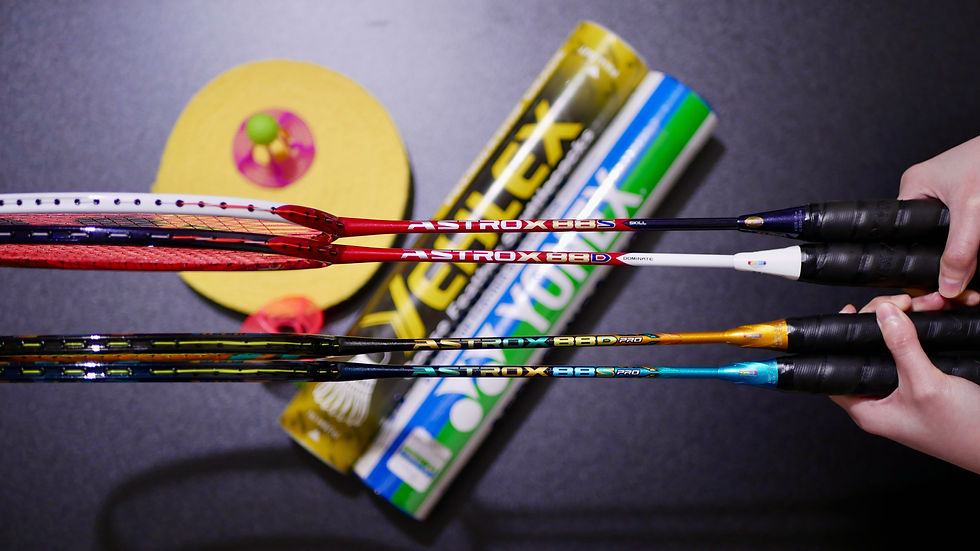
So let's now talk about the Astrox 88S Pro. You may be aware that Yonex has launched a new Pro model for both the Astrox 88S and Astrox 88D. However, what I found is that plenty of players are sticking with the second generation models of the Astrox 88. There are almost an equal amount of players playing with the second generation rackets as the current Pro models rackets. For example, Wang Yi Lyu of China, who is one half of the Mixed Doubles gold medal pair, used to play with the Astrox 88D Pro before swapping to the second generation Astrox 88S for the Tokyo Olympics.
Meanwhile, I also noticed that Azerbaijan's Ade Resky Dwicahyo was playing with the Astrox 88S in his first game against Anders Antonsen, and swapped back to his usual Duora 10 after the mid-game interval, which I find rather interesting. This goes to show that professional players are also similar to us amateur players who tend to swap around rackets in search for the ultimate best racket.
Back to the Astrox 88. There were plenty of big-name players playing with all four models (Astrox 88S, Astrox 88D, Astrox 88S Pro and Astrox 88D Pro) at the Tokyo Olympics so I'm just going to pick a few to name here. For the Astrox 88S Pro: Kevin Sanjaya Sukamuljo (Indonesia), Stefani Stoeva (Bulgaria), Li Yinhui (China), Sayaka Hirota (Japan), Takeshi Kamura (Japan), Wakana Nagahara (Japan), Selena Piek (Netherlands) and Sapsiree Taerattanachai (Thailand). For the second generation Astrox 88S, we have Wang Yi Lyu (China), Ben Lane (GB), Godwin Olofua (Nigeria), Busanan Ongbamrungphan (Thailand), Dechapol Puavaranukroh (Thailand) and also Mark Lamsfuss (Germany) who was still playing with the Voltric 80 ETune earlier this year!
The Astrox 88D Pro has players such as Marcus Fernaldi Gideon (Indonesia), Keigo Sonoda (Japan), Yuki Fukushima (Japan) and Soh Wooi Yik (Malaysia), Lee Meng Yan (Malaysia), Soniia Cheah (Malaysian) and Nguyen Thuy Linh (Vietnam). And finally, for the second generation Astrox 88D, we have Marvin Seidel (Germany), Mark Caljouw (Netherlands), Ivan Sozonov (ROC), Vladimir Ivanov (ROC), Kim So Yeong (Korea), Neslihan Yigit (Turkey) and Tang Chun Man (Hong Kong).
The new model rackets aside, there are also a few players using legendary rackets such as the old school sledge hammer, the Voltric Z Force 2, such as Marcus Ellis (GB), Lauren Smith (GB), Sai Praneeth (India) and Niluka Karunaratne (Sri Lanka).
I am not too sure what the other players outside of Yonex are playing with. For example, I think Chen Long is playing with an unreleased Li Ning model racket (feel free to correct me if I'm wrong) so I've left it blank for now. I also wasn't able to determine 2 players' rackets, they are Brazil's Ygor Coelho, and Bulgaria's Linda Zetchiri. Both of them did not have a stencil that I could recognise on their racket strings so if you know the specific racket models these players played with, please put them down in the comments section below and I will update my data accordingly.
So I hope you guys like this post, and do check out my YouTube video on this topic!


Gần đây thấy cái tên cakhiatv được nhắc đến tương đối nhiều trong các bài chia sẻ kinh nghiệm nên mình quyết định ghé qua quan sát. Ấn tượng đầu là nền tảng xử lý phần nhìn rất thông thoáng, bảng điểm số thể thao và không gian bàn cược live casino không bị trộn lẫn vào nhau. Phân khu dành cho các tựa game slot cũng được gom tụ chuẩn chỉ tại mỗi sảnh game. Trang web thể hiện một bố cục hợp lý, việc định vị các mục quan trọng rất trực quan và không gây cảm giác quá tải dữ liệu.
<p>Với chủ đề thể thao và kết quả thi đấu, mình nghĩ lịch thi đấu dày là điều nên được giải thích rõ. Với người mới, các bước cơ bản được mô tả rõ sẽ rất hữu ích. Cá nhân mình nghĩ nên tách dữ liệu thể thao và quảng cáo dịch vụ; với go88 cũng cần kiểm tra nguồn trước.</p>
Rikvip mình thấy bạn bè nhắc hoài nên cũng ghé xem thử cho biết, chủ yếu tò mò giao diện thôi. Vừa vào là thấy trang nhìn sáng sủa, khoảng trắng vừa đủ nên không bị ngộp chữ. Mình thích nhất là cách họ chia nội dung theo từng khối rõ ràng, kéo xuống một chút là nắm được chỗ nào đang nói về gì, không phải căng mắt dò. Mấy phần thông tin trình bày dạng danh sách ô nhìn gọn, đọc lướt nhanh vẫn hiểu, kiểu phù hợp lúc đang bận mà muốn xem qua. Menu đặt khá dễ thấy nên bấm qua lại cũng mượt, không bị cảm giác “lạc” trong trang. Nói chung cảm giác dùng…
8xbet mình thấy dạo này nhắc nhiều quá nên tò mò vào lướt thử cho biết thôi, chứ cũng không đăng ký hay chơi gì. Vừa vào là thấy họ trình bày theo kiểu chia khối nội dung khá rõ ràng, nhìn phát biết chỗ nào là tin cập nhật link truy cập, chỗ nào nói về giấy phép pháp lý, đỡ phải kéo tìm mệt. Mình để ý có đoạn cảnh báo chuyện có website giả mạo, họ nhắc người dùng tự kiểm tra trước khi vào nên đọc cũng thấy yên tâm hơn chút, kiểu nhắc thẳng luôn trong bài chứ không giấu. Nói chung giao diện không rối, tiêu đề to dễ đọc, và phần “cập nhật…
Sunwin mình thấy dạo này hay được nhắc nên cũng bấm vào coi thử cho biết, kiểu tò mò thôi chứ không có chơi gì. Vừa vào là thấy họ để mục “link tải mobile 2026” khá dễ nhìn, nằm nổi bật nên khỏi phải lục lọi. Mình lướt tiếp qua phần nói về lịch sử phát triển thì cách trình bày theo từng khối rõ ràng, đọc nhanh vẫn hiểu ý chính, không bị rối mắt. Mấy tiêu đề heading đặt ngay trên đoạn nội dung nên kéo xuống tới đâu là biết mình đang đọc phần nào tới đó. Nói chung cảm giác trang này sắp xếp thông tin gọn gàng, nhất là cái heading “tổng quan về…